Showing posts with label science fiction. Show all posts

13 January 2012

Dr. Who: A Christmas Carol


                Dr. Who: A Christmas Carol is a retake and satire of the classic tale with a 900-year-old, time travelling, bow-tie wearing personality thrown in for good measure. Called “The Doctor”, he spirits down to serve as the lifesaving spirit of Christmas for an elderly miser. Also, he has a blue box that travels through time & space and is bigger on the inside. Minor details taken care of, Allons-y!
                Our future-contemporary Scrooge is Kazran Sardick, a peevish and empty man. The worst the world can offer, We the Viewers are led to believe, in his opening actions he withholds aid for a crashing spaceliner, condemning 4003 passengers for personal spite. The audience is made to believe he lacks empathy, mercy, human spirit. However, while furious, he refuses to strike a child.
With a blue-box-trip to Kazran’s past, The Doctor observes the violent relationship between Kazran’s father and young Kazran. To save the 4003 crashing decades later, The Doctor decides to serve as young Kazran’s better influence.
The perspective of Evil takes a generational-curse stance here. Not being shown another negative source in his life, the episode places the sins of the Father as the source of evil spread to the son. A black & white worldview character, The Doctor places himself in a place to change time.
The character arc followed by the episode attempts redemption. Using The Doctor as a Kingdom arbiter, the episode assumes promoting a life lived in joy will make Kazran a better man. This does not hold true.
 Failure occurs when the personal price of Kazran’s redemption comes from the woman he falls for as a result of The Doctor’s intervention. Well-meant intentions worked for Dicken’s ghosts, but The Doctor is a mortal agency, and never considers the cost of his actions. In fact, he absolves himself before his work begins. From the transcript Here:
DOCTOR:
There are 4,003 people I won't allow to die tonight. Do you know where that puts you?

KAZRAN:
Where?

DOCTOR:
4,004.

KAZRAN:
Was that a sort of threat-y thing?

DOCTOR:
Whatever happens tonight, remember... you brought it on yourself.
                By the end of the episode, Kazran accepts the price of The Doctor’s failure. As a Christmas story, a cheerful slant is cleverly applied, in Dickensian humor. However, the assumption of The Doctor as a godlike figure is cast into a bitter light. The conclusion asks We the Viewers “how far can we redeem ourselves?” Their answer is “to a place neither black or white, a gray between” At the end of the episode:
the DOCTOR looks up at the sky.

DOCTOR:
Halfway out of the dark.

1: Can “halfway out of the dark” be acceptable for a Kingdom citizen, or even possible? How is our fallen state a place for Christian culture to thrive?
2: The promotions for the show used the tagline “time- can be rewritten”. Will the work of others allay our responsibility in past deeds? How is our redemption not dependent on ourselves? How is it dependent?

23 January 2010

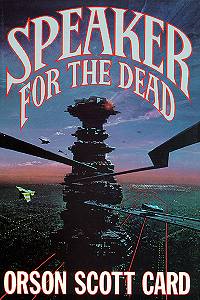
Speaker for the Dead


Speaker for the Dead is a science fiction novel written by Orson Scott Card. It is an indirect sequel to Card’s most famous novel, Ender’s Game, and is set 3,000 years after the previously mentioned’s events. On the planet Lusitania, humans have discovered another alien species. This discovery was viewed by many as a chance for humanity to redeem itself after its destruction of the Buggers. In order to leave this new race, Pequininos or “Piggies,” relatively undisturbed, only two human xenobiologists are allowed to have any contact with the new race – only observing them so that humanity will have a better understanding of this species. This time around, humanity declares that there will be no misunderstanding and no xenocide. However, Andrew Wiggin is called to Lusitania to speak the deaths of the two xenobiologists, and arrives at a scene of hatred and fear. He must discover and understand the many secrets involving the lives of the Piggies and those who study them in order to speak for the dead. He must speak not only for the dead xenobiologists, but also for an entire alien race.

“Andrew sighed at Styrka’s unforgiving attitude; it was the fashion among Calvinists at Reykjavik to deny any weight to human motive in judging the good or evil of an act. Acts are good and evil in themselves, they said; and because Speakers for the Dead held as their only doctrine that good or evil exist entirely in human motive, and not at all in the act, it made students like Styrka quite hostile to Andrew. Fortunately, Andrew did not resent it – he understood the motive behind it.” (Speaker for the Dead, page 26.)

One aspect of Card’s writing that distinguishes him from most other science fiction authors is his inclusion of moral and religious concerns into his novels. (This is very likely due to the fact that Card is a devout Mormon.) Speaker for the Dead is no exception, integrating humanistic and Christian ideas. One idea thoroughly explored is that “good or evil exist entirely in human motive, and not at all in the act.” This is a very humanistic, postmodern idea that has been hotly debated in recent years. While I personally do not believe this idea is true, the book does offer some compelling arguments for and against it. The “Piggies”, for instance, believe that the greatest honor for an individual is to be killed and implanted with a tree, thus allowing future life to occur. (The practice is more complicated than that, but this at least gives a good, general idea of the “Piggies” “New Age”ish philosophy.) During the course of the book, the Piggies perform this practice on two humans. Were these two murders sin?

One other key aspect of the book is, appropriately enough, “speaking for the dead.”This practice is done by a “Speaker.” These individuals, when called for, research a dead person's life and present a speech that attempts to speak for the dead person, describing his or her life as he or she tried to live it. This speech is not made in an attempt to persuade the audience to forgive or condemn the dead, but rather as an attempt to understand the person’s life as a whole. No punches are pulled. The truth is told as it is. I believe this practice is in line with the kingdom. Not only because it presents truth, but also because many would argue that if one really understands someone well enough to speak for him or her when he or she is dead, one will end up loving him or her - or at least have a good understanding of why he or she made the choices that he or she did. I find the idea of such a strong link between truth and love to be very powerful and worthy of further inspection.

While there are many more ideas and themes found in the book that I’d love to discuss, these two will have to suffice. I would highly recommend reading both Ender’s Game and Speaker for the Dead to anybody remotely interested in science fiction and who wants a book that does a good job incorporating and discussing morality, philosophy, and religion.

Discussion Questions:
- Does good or evil exist entirely in human motive, and not at all in the act? Why or why not?
- Do you believe that truth and love are strongly linked? If you have complete understanding of an individual, will you always end up loving them? Does this idea support God’s love for all of us?

Google link (Assorted Pages): http://books.google.com/books?id=8_ws8CZe66AC&dq=speaker+for+the+dead+orson+scott+card+note+at+end+of+audiobook&printsec=frontcover&source=bn&hl=en&ei=eJ1bS5XwCpX8M-mmkIsP&sa=X&oi=book_result&ct=result&resnum=4&ved=0CBYQ6AEwAw#v=onepage&q=&f=false