24 January 2010

Family Guy

For my second blog post, I chose to watch a 1/2 hour of Family Guy on tv. The episode starts with the son, Chris, getting expelled from his school because he is too stupid. Throughout the episode Chris tries to get into multiple schools, special, military, and private, but in the end (after many jokes, gags, and hilarious scenes), Chris ends up being able to return to his old public school thanks to his grandfather who pulled some strings.

Parts of the empire can be seen in this episode, although it is hard to see them through the jokes that Family Guy puts in every other scene. When Chris goes to a large private school, attended only by insanely rich students, he is mocked, beaten up, and prejudiced against because he is poor. The rich lifestyle of the students is completely different from what he has grown up with, and therefore rejects him. For me it sort of shows how separated social systems can become, especially in America. If you don’t have an incredible amount of money, the right clothes, the perfect car, or other things like that, you do not belong until you finally do obtain those things. This is a message of the empire.

The kingdom on the other hand, is the complete opposite. Welcoming, warm, and not caring about credentials or other worldly things, the kingdom will take in anyone who is willing. Knowing this, we should not try so hard to obtain worldly things like status, power, and money, because in the end, in the kingdom, these things will mean nothing. In the empire, however, these things are everything worth living for. We should ask ourselves what worldly things we are personally trying so hard to get, and start looking at the things that really matter.

The Hurt Locker


Hurt Locker is a movie about SFC William James in the Iraq war as he works as the leader of a Explosive Ordnance Disposal (EOD) unit, which consists of Sergeant JT Sanborn, Specialist Owen Eldridge , and himself. Through the movie we are led by James, who is a very wild and lively personality, as he leads his unit in disarming IEDs and other types of bombs, while risking their lives to do so. The film is very intense and displays graphic images of war and the effects of war on the human psyche, particularly with American troops in Iraq. The only part of the movie that I strongly disliked was the ending, where James finally gets home to his family, and he realizes that Iraq was actually a good place for him to be, so he leaves his family and goes back. If James really liked war better than his family, then that is really sickening. He is then showing preference towards an Empire type gift, and not preferring the God-given gift. The message that I received from The Hurt Locker was that is was trying to show that as long as there is war; we should find our niche within it.
While I do not think that the original intent of this movie was entirely true or righteous, there are still some lessons we can take from it. The real human purpose is to live in harmony among each other, while praising God and respecting his world that we live in. But since we are in a world that has fallen into sin, not everyone praises Goad and respects his world, as Hurt Locker attests. A major origin of evil comes from war, and we see this in Hurt Locker through some of the character’s attitudes towards war, and how it affects them personally. The Hurt Locker also shows us how the empire wants us to submit to our instincts with war, such as supporting it, and spreading it. But really what we should be doing is loving our neighbors, promoting peace, and building alliances, which is what the kingdom looks like in view of war.

1. How should major governments come up with alternatives to war?

2. What are some specific characteristics of Empire that cause/ are in support of wars? What are some characteristics of Kingdom that subvert war?

23 January 2010

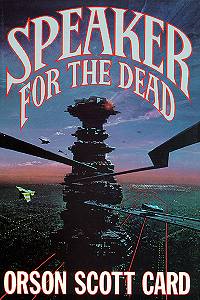
Speaker for the Dead


Speaker for the Dead is a science fiction novel written by Orson Scott Card. It is an indirect sequel to Card’s most famous novel, Ender’s Game, and is set 3,000 years after the previously mentioned’s events. On the planet Lusitania, humans have discovered another alien species. This discovery was viewed by many as a chance for humanity to redeem itself after its destruction of the Buggers. In order to leave this new race, Pequininos or “Piggies,” relatively undisturbed, only two human xenobiologists are allowed to have any contact with the new race – only observing them so that humanity will have a better understanding of this species. This time around, humanity declares that there will be no misunderstanding and no xenocide. However, Andrew Wiggin is called to Lusitania to speak the deaths of the two xenobiologists, and arrives at a scene of hatred and fear. He must discover and understand the many secrets involving the lives of the Piggies and those who study them in order to speak for the dead. He must speak not only for the dead xenobiologists, but also for an entire alien race.

“Andrew sighed at Styrka’s unforgiving attitude; it was the fashion among Calvinists at Reykjavik to deny any weight to human motive in judging the good or evil of an act. Acts are good and evil in themselves, they said; and because Speakers for the Dead held as their only doctrine that good or evil exist entirely in human motive, and not at all in the act, it made students like Styrka quite hostile to Andrew. Fortunately, Andrew did not resent it – he understood the motive behind it.” (Speaker for the Dead, page 26.)

One aspect of Card’s writing that distinguishes him from most other science fiction authors is his inclusion of moral and religious concerns into his novels. (This is very likely due to the fact that Card is a devout Mormon.) Speaker for the Dead is no exception, integrating humanistic and Christian ideas. One idea thoroughly explored is that “good or evil exist entirely in human motive, and not at all in the act.” This is a very humanistic, postmodern idea that has been hotly debated in recent years. While I personally do not believe this idea is true, the book does offer some compelling arguments for and against it. The “Piggies”, for instance, believe that the greatest honor for an individual is to be killed and implanted with a tree, thus allowing future life to occur. (The practice is more complicated than that, but this at least gives a good, general idea of the “Piggies” “New Age”ish philosophy.) During the course of the book, the Piggies perform this practice on two humans. Were these two murders sin?

One other key aspect of the book is, appropriately enough, “speaking for the dead.”This practice is done by a “Speaker.” These individuals, when called for, research a dead person's life and present a speech that attempts to speak for the dead person, describing his or her life as he or she tried to live it. This speech is not made in an attempt to persuade the audience to forgive or condemn the dead, but rather as an attempt to understand the person’s life as a whole. No punches are pulled. The truth is told as it is. I believe this practice is in line with the kingdom. Not only because it presents truth, but also because many would argue that if one really understands someone well enough to speak for him or her when he or she is dead, one will end up loving him or her - or at least have a good understanding of why he or she made the choices that he or she did. I find the idea of such a strong link between truth and love to be very powerful and worthy of further inspection.

While there are many more ideas and themes found in the book that I’d love to discuss, these two will have to suffice. I would highly recommend reading both Ender’s Game and Speaker for the Dead to anybody remotely interested in science fiction and who wants a book that does a good job incorporating and discussing morality, philosophy, and religion.

Discussion Questions:
- Does good or evil exist entirely in human motive, and not at all in the act? Why or why not?
- Do you believe that truth and love are strongly linked? If you have complete understanding of an individual, will you always end up loving them? Does this idea support God’s love for all of us?

Google link (Assorted Pages): http://books.google.com/books?id=8_ws8CZe66AC&dq=speaker+for+the+dead+orson+scott+card+note+at+end+of+audiobook&printsec=frontcover&source=bn&hl=en&ei=eJ1bS5XwCpX8M-mmkIsP&sa=X&oi=book_result&ct=result&resnum=4&ved=0CBYQ6AEwAw#v=onepage&q=&f=false

The Simpsons-The Great Wife Hope

For my 2nd blog, the cultural artifact I chose was The Simpsons “The Great Wife Hope.” This episode begins with Marge and her friends bowling. They wonder where all the men are because they are nowhere to be found. All the men are at an arena watching the Ultimate Punching Kicking and Choking Championship. This upsets Marge because Bart experiments what he sees at school. Marge then goes to the arena and accepts a challenge from the owner. If Marge beats up the owner, then he will tear the arena down and stop the violence. Marge begins to train for the fight. Marge ends up beating the owner, but none of the guys learn the lesson that she is trying to teach.

Bits of the empire can be seen throughout this episode of The Simpsons. Because Homer took Bart to the wrestling arena, Bart then thinks this stuff is ok to do. So Bart experiments with it at school and starts to beat up kids and take their lunch money. Marge is angry at this type of wrestling and is also angry at the arena for influencing this to children so they can try it on their own. This is like the empire because it is deceptive. It is giving examples of things that are wrong and saying that it is ok to do. Another way the empire can be seen through this episode is through the owner of the arena. He is reinforcing his power through violence by challenging Marge to a fight. One other thing that represents the empire in this episode is the normality of fighting. At the end when Marge is trying to teach a lesson, everyone leaves when they find out that two drunken guys are fighting outside. Fighting seems normal to the men and they feel they have to go and watch and that it is the thing to do.

What other examples of empire can we see through other professional sports? What can we do to help put an end to these problems?

Banksy attacks West Bank Wall


Banksy is an unknown graffiti artist believed to be from England. He is thought to be from the town Yate, near Bristol but the public is uncertain. His style consists of mainly satirical stencils often a commentary on society or politics. A lot of it very similar to Blek le Rat. His art appears in cities all around the world. And he doesn't make any money off his work because he doesn't sell any of it. Some of his more famous works have been found on the West Bank Wall that separates Israel from Palestine. Stenciling huge windows, balloons, holes, and ladders all over the 425 mile long wall. The ultimate holiday spot for tag artists. But Banksy feels that the wall "essentially turns Palestine into the world's largest open prison."

Banksy's art is trying to get at the original purpose of humans. To live in community with one another. The graffiti he has created is his attempt to show people that this separation is not the way God intended them to live. This massive wall blocks community from occurring. It is meant to separate two different cultures. Jo Brooks, Banksy's spokeswoman, reported that "The security forces did shoot in the air threateningly and there were quite a few guns pointed at him." This was during one of his works of dotted lines with the scissors for the infamous symbol for 'cut out'. Another time he was told by and old Palestinian man that the painting was making the wall beautiful, but that "We don't want it to be beautiful, we hate this wall. Go home." SO the wall is hated by some, but it is still up.
  • Do you think what Banksy is doing is illegal?
  • Do you think any of his work is effective?

Love the mall? Then why don't you move into it.

After reading Meghan's assessment that malls have pretty much everything we need (so why wouldn't we love to spend lots of time there?), I was reminded of the story from a couple of years ago about a couple who literally moved into a mall and lived illegally in an unused portion of the building. Check out the Salon story here and the post on a blog here, which has a photo and more links, including video. Perhaps one of you might consider moving into the mall as a practice for one of your final project communities? ;)

Second Cultural Artifact by Miki

The film District 9 was indeed a highly enjoyable, satisfying, and in its own right, disturbing experience. To say that I had fun with it would be an understatement. Not only did I have fun with it, I broke out into song, singing praises of its greatness. District 9 takes place in modern day South Africa, specifically Johannesburg. In the film, an alien spacecraft is found in low orbit above the city , and upon inspection, a new, sentient species is discovered. As the new species is not human, they are placed in poorly constructed slums and scrape a living off of appalling conditions. The protagonist travels to the slums, and upon arriving, quickly becomes entangled in a desperate struggle to uncover the truth and and see justice done.
District 9 holds a number of lessons applicable to our current day and age. Although ethics of DNA extraction for alien weaponry use is hardly relevant, the principles behind the examples used in the film certainly are. Unfair and unethical treatment of those considered "sub-human" has continued over the years despite countless struggles to eradicate such atrocious action. Racial discrimination, slavery, prostitution, and ethnic genocide are but a few examples of unspeakable horrors being committed everyday. District 9 does a marvelous job at both subtlety and direct confrontation in pointing out how these problems are still prevalent and growing.
Although District 9 helps illuminate the issues at large, it does little in the way of offering practical or ethical solutions. Naturally, offering such a solution is not the goal of the film, but rather to ask the questions and provoke its audience into thinking and analysis. And thus here we are. What do we do about the problems of racial tension and ethno-national conflict? The Kingdom of God is unfortunately not with us, but we must strive to see it come to fruition on earth. Perhaps we must expand our minds and think creatively to solve these issues. Or perhaps these issues can only be fought within the boundaries of "the system". What do you think?

Brick By Boring Brick


Paramore's new single "Brick By Boring Brick" seems to fit nicely into David Dark's definition of apocalyptic. The song (and especially the video, worth checking out) tells the story of a young girl-princess who "lives in a fairy tale." This fairy-tale world is the antithesis of the real world of "taste and smell." Perhaps many Christians today could place themselves in a similar Docetic dreamland, having "built up a world of magic/because your real life is tragic." The song advises that the fairy-tale girl needs to "Keep [her] feet on the ground/while [her] head's in the clouds," in other words stop trying to fly by clutching at butterflies and only managing to rip off their wings.

This first part of the story serves as an apocalyptic wake up call: "The real world is tragic and harsh, but you can't escape it." This is an important realization, but often leads to an overemphasis of worldliness and a despair that tries to cope with brutal reality. In "Brick By Boring Brick," this despair is represented in the chorus which exhorts everyone to get a shovel and bury "the castle," the imaginary home we've built up for ourselves in dreamland. The new home is not fanciful, but rather made "brick by boring brick" so no wolves can blow it down. However, how satisfying is this compromise? Certainly no one wants to live in a boring brick house, no matter how sturdy it is.

This is where the song takes a hopeful and (I'd argue) spiritual turn. In the bridge, the little girl is accused of having "built up a world of magic," but then the narrator chimes in with a version of C.S. Lewis' Argument from Desire. The song explains that "If [fairy land is] not real/you can't hold it in your hand/you can't feel it with your heart/and I won't believe it/but if it's true/you can see it with your eyes/or even in the dark/and that's where I want to be, yeah." Essentially, if no fairly land existed we wouldn't be able to wish for it, but if it is real it can be felt no matter the circumstances. This realization, this hope, is the rebirth of the little girl. Here I rely in the video, as the little girl falls headlong into the grave of the castle, Hayley, who is dressed exactly the same and seems to be the grown-up version of the little princess, walks away into a world covered in gold. The death of her perfect dream has not meant the death of her hope, even in the dark realities of life her hope shines all the more beautiful.

The empire tends to have two stories: either life is perfect and doesn't need any more attention or life is terrible and nothing can be done. Either way, reality is inevitable and hope doesn't really have a place. However, life in the Kingdom provides hope in the midst of darkness, neither is the world perfect or irredeemable but Christ is Lord over all. In Him we find the strength to carry on, and above that, radiate His glory.

Questions:
1. How can hope transform our outlook on life? How is it possible that Christ's power is made perfect in weakness (II. Cor. 12:9)?
2. How do you interpret the ending of the song and the video? Do the girl's fanciful beliefs leave her vulnerable unto death, or is she reborn stronger? Where is Hayley walking to as the video fades?

22 January 2010

Grey's Anatomy

Grey's Anatomy, is a drama fallowing the lives of multiple doctors in Seattle Grace Hospital. In the latest episode, Christina is struggling with a decision of whether to choose love over career. Christina is currently a resident under surgeon Teddy Altman, who is in love with her boyfriend. Dr. Altman decides she must leave the hospital to get over Owen, Christina’s boyfriend. In a moment of panic Christina tells Teddy that she can have Owen if it means she’ll stay at the hospital. Along with other interesting twists the episode ends, yet again, with a catch.

There are many conflicting ideas in this drama that are attempting to answer what truly the human purpose is. Christine feels that her purpose lies in career and the feeling of accomplishing something meaningful, while other characters feel that love is what matters, finding the one you love. Grey’s Anatomy, though fictional, is an excellent picture of present day ideals and morals. The human purpose depends on the human. Purpose is different for each individual, and everyone’s idea of purpose is right. This idea can cause many issues, and create conflict, as seen in the episode. As Christians, the human purpose is to glorify God, not to please your desires.

Throughout Grey’s Anatomy many life altering decisions are being made. This is what keeps the show interesting. Many of the character’s decisions are poor, and the viewers can see the results of those decisions. Evil disguises itself in many forms. Evil can be very tricky and deceptive causing people to stumble, as we can see in Grey’s Anatomy. The empire’s affect can be seen throughout this show. Desires are met while trust and relationships are broken. Evil works through the disguise of the empire and thought that we should have what we want no matter what. Evil wants to isolate and meet desires keeping one unsatisfied and alone. This can be seen throughout the show in many characters.

Grey’s Anatomy is a thrilling show full of scandal, twists, and suspense, and though it may be enjoyable one must realize that the life styles displayed in the show are destructive and not Kingdom oriented. God intended us to be in healthy community.


Discussion Questions:

  1. Do you agree with Christine’s decision to fallow her career even if it means breaking the trust of someone who loves her?
  2. How might a Christian go about this hard decision of choosing career over family or relationship?

Private Practice

Private Practice is about a group of doctors who work in L.A. They are all friends and are all connected in some way or another whether it is by blood or romantically. This specific episode was about Mia, who is the daughter of Sam and Naomi, divorced doctors who work at the practice. She discovers that she is pregnant, even though she is only fifteen. Naomi freaks out and demands that Mia get an abortion immediately, even though she is against abortion and believes that the baby’s life begins right after it is conceived. After seeing another woman’s pain in trying to do a natural childbirth, Mia agrees. Addison, Naomi’s best friend will perform the abortion. However, at the last moment, Mia decides that she does not want an abortion. Naomi is furious and marches her into the room of the lady undergoing the natural childbirth. Instead of getting scared and nervous, Mia is filled with joy as she sees the little baby being handed to the mother for the first time.
This very brief overview of the episode shows us the struggles and problems of living in this empire. Human sin is very prevalent in this episode, the fact that Mia got pregnant at such a young age, the way her mother, Naomi, reacts to the situation. Naomi wants a quick and easy solution that will make the whole issue go away so that her family can continue to function like nothing happened. This is a prime example of the way that the empire wants us to act us to situations like this. They encourage us to do whatever makes us happy, and if problems arise, then take the quick and easy way out and everything will be ok. However, the episode did not end there. There is a small glimmer of hope as Mia decides to not undergo an abortion. This decision shows an example of redemption. Although Mia is in a very tough situation, she makes the choice to keep her baby. She chose to give this baby a life and a future instead of treating it like a mistake and having an abortion.
Discussion Questions:
1. What would have been a better reaction for Naomi to have after she heard about her daughter’s pregnancy?
2. What lessons can we learn about the empire from this episode concerning how it wants us to act when problems from previous choices arise?